

Why Some Colorectal Cancers Resist Immunotherapy and How Science Aims to Fight Back
Researchers trace the genetic and environmental barriers to immunotherapy in mismatch repair-deficient colorectal cancers.
Key takeaways
- Approximately 15% of localized and 5% of metastatic colorectal cancers exhibit mismatch repair deficiency (dMMR) or high microsatellite instability (MSI-H).
- Between 15% and 46% of dMMR/MSI-H colorectal cancer patients experience primary resistance to immune checkpoint inhibitors.
- Tumor-intrinsic resistance factors include defects in TAP1/TAP2 and beta 2-microglobulin (b2m), as well as oncogenic Wnt/beta-catenin and JAK/STAT signaling.
- The immunosuppressive tumor microenvironment contributes to resistance via T-cell exclusion and myeloid-derived suppressor cell (MDSC) accumulation.
- Emerging strategies to overcome resistance include third-generation immune checkpoint inhibitors targeting LAG-3, TIM-3, and TIGIT, as well as gut microbiome modulation.
Colorectal cancer remains a leading cause of cancer-related mortality worldwide, presenting a persistent challenge for oncologists and patients. Within this patient population, approximately 15% of localized colorectal cancer cases and 5% of metastatic cases exhibit specific genetic characteristics: mismatch repair deficiency (dMMR) or high microsatellite instability (MSI-H).
For patients with these specific biomarkers, immune checkpoint inhibitors have revolutionized first-line treatment. However, the therapy is not universally successful. Between 15% and 46% of patients with dMMR or MSI-H colorectal cancer experience primary resistance to these immunotherapies, and a subset of responders eventually acquires resistance over time.
In a review published in the Journal of immunology research in July 2026, researchers synthesized the multifaceted mechanisms underlying this resistance. The publication outlines tumor-intrinsic alterations and microenvironmental factors that prevent immunotherapy from working, while highlighting emerging therapeutic strategies designed to overcome these barriers.
What Happened
The review analyzed the biological pathways that allow dMMR/MSI-H tumors to evade the immune system despite treatment with checkpoint inhibitors. The researchers categorized these hurdles into tumor-intrinsic alterations and microenvironmental barriers.
Inside the tumor cells, genetic and epigenetic changes block the immune system's ability to recognize cancer. These include defects in the antigen presentation machinery—specifically involving transporter associated with antigen processing 1 and 2 (TAP1 and TAP2) and beta 2-microglobulin (b2m). Additionally, the review identified active oncogenic signaling through the Wnt/beta-catenin and JAK/STAT pathways, alongside epigenetic remodeling involving ARID1A, as key drivers of tumor-intrinsic resistance.
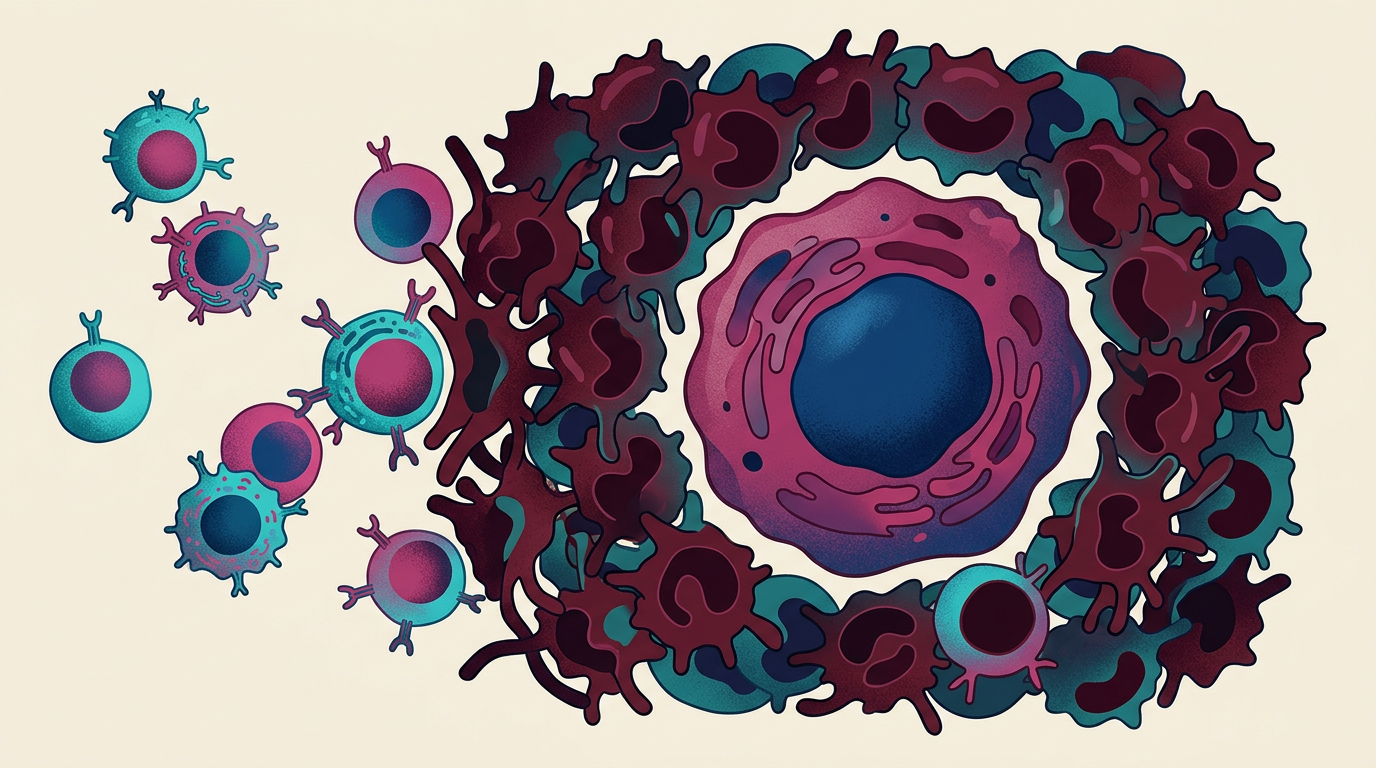
Outside the cells, the tumor microenvironment itself plays a defensive role. The review highlights how an immunosuppressive tumor microenvironment, characterized by the exclusion of T-cells and the accumulation of myeloid-derived suppressor cells (MDSCs), actively prevents immune cells from attacking the tumor.
What The Evidence Shows
The paper published in the Journal of immunology research (PMID: 42590903) acts as a comprehensive synthesis of current literature regarding immunotherapy resistance in dMMR/MSI-H colorectal cancer. It details how primary resistance affects 15% to 46% of these patients and outlines the scientific consensus on both cellular pathways (TAP1/TAP2, b2m, Wnt/beta-catenin, JAK/STAT, ARID1A) and microenvironmental features (T-cell exclusion and MDSC accumulation) that govern this resistance.
What We Don't Know Yet
As a literature review, this paper synthesizes existing findings and does not present new clinical trial data or patient outcomes. The source text does not report specific limitations, clinical trial sample sizes, or patient demographic variations across the synthesized studies.
What Comes Next
To address the documented mechanisms of resistance, the review evaluates several emerging strategies. These include third-generation immune checkpoint inhibitors that target lymphocyte activation gene 3 (LAG-3), T-cell immunoglobulin and mucin-domain-containing-3 (TIM-3), and TIGIT.
Additionally, researchers point to novel therapeutic approaches such as bispecific antibodies (BsAbs) and adoptive cell transfer as potential pathways to overcome resistance. The review also highlights the clinical potential of biomarker strategies, including gut microbiome modulation and circulating tumor DNA (ctDNA) dynamics, to guide future precision treatment. The published source does not outline specific timelines or next steps for clinical trials.
What This Means
This research highlights that overcoming immunotherapy resistance requires a personalized, multi-targeted approach rather than a one-size-fits-all solution. By mapping the exact genetic defects and microenvironmental barriers, clinicians can transition from general immunotherapy to precision oncology strategies tailored to a tumor's specific resistance profile.
Original Source
PubMed (NCBI E-utilities): https://pubmed.ncbi.nlm.nih.gov/42590903/
Questions readers ask
- What is dMMR/MSI-H colorectal cancer?
- This is a subtype of colorectal cancer characterized by mismatch repair deficiency (dMMR) or high microsatellite instability (MSI-H). It represents about 15% of localized and 5% of metastatic colorectal cancer cases.
- How common is immunotherapy resistance in dMMR/MSI-H colorectal cancer?
- While immune checkpoint inhibitors have revolutionized first-line treatment, 15% to 46% of patients experience primary resistance. Additionally, some patients who initially respond to treatment eventually acquire resistance over time.
- What biological mechanisms cause this immunotherapy resistance?
- Resistance is driven by both tumor-intrinsic alterations and the tumor microenvironment. Key mechanisms include defects in the antigen presentation machinery (TAP1/TAP2 and b2m), signaling pathways like Wnt/beta-catenin and JAK/STAT, and epigenetic remodeling involving ARID1A, alongside T-cell exclusion and myeloid-derived suppressor cell (MDSC) accumulation.
- What new treatments are being explored to overcome this resistance?
- Researchers are evaluating third-generation immune checkpoint inhibitors targeting LAG-3, TIM-3, and TIGIT. Other emerging approaches include bispecific antibodies (BsAbs), adoptive cell transfer, gut microbiome modulation, and circulating tumor DNA (ctDNA) dynamics.
What this means
This research highlights that overcoming immunotherapy resistance requires a personalized, multi-targeted approach rather than a one-size-fits-all solution. By mapping the exact genetic defects and microenvironmental barriers, clinicians can transition from general immunotherapy to precision oncology strategies tailored to a tumor's specific resistance profile.
Limitations and uncertainties
- As a literature review, this paper synthesizes existing findings and does not present new clinical trial data or patient outcomes. The source text does not report specific limitations, clinical trial sample sizes, or patient demographic variations across the synthesized studies.